
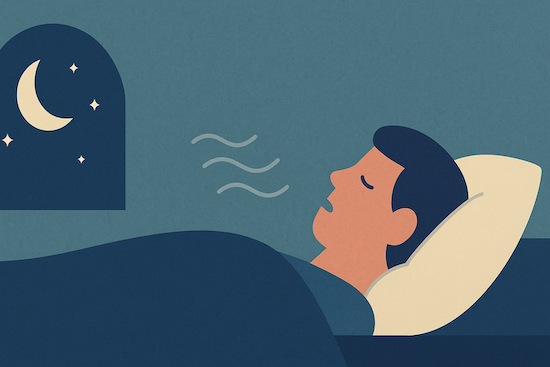
In brief: Which breathing signs to discuss with a clinician and what to do next.
Snoring and breathing signals: when nighttime sounds matter
Snoring can be harmless — or a sign of something more serious.
Breathing pauses during sleep can be a reason to seek assessment for sleep apnoea; this article cannot diagnose it [18].
Why breathing at night matters
Healthy sleep depends on regular, unobstructed breathing.
When airways narrow or collapse, the brain briefly wakes up to restore airflow.
In obstructive sleep apnoea, repeated breathing interruptions may fragment sleep and affect oxygen levels; symptoms should be assessed rather than inferred from this test.
Common signs
- Loud, frequent snoring
- Observed breathing pauses during sleep
- Gasping or choking at night
- Daytime tiredness despite enough time in bed
- Morning headaches or dry mouth
Risk factors
- Overweight or obesity
- Alcohol use (especially in the evening)
- Smoking
- Sleeping on your back
- Age and male gender (though anyone can be affected)
If these signs concern you, describe them to a clinician, including anything a bed partner has noticed.
Practical tips
- Sleep on your side: A pillow behind your back may make side sleeping easier; it is not treatment for diagnosed apnoea.
- Avoid alcohol late: Alcohol late in the evening may worsen breathing symptoms for some people.
- Maintain a healthy weight: If weight is a concern, discuss suitable steps with a clinician rather than assuming a change will resolve apnoea.
- Keep your nose clear: Treat allergies or nasal congestion that make breathing harder.
When to seek help
If your partner notices breathing pauses, or if you’re very tired despite long nights in bed, talk to your doctor.
A clinician can assess whether CPAP (a device that supports breathing), a dental device or another approach is appropriate.
CPAP supports breathing during sleep. Your clinician can discuss whether it fits your situation.
What the signs can and cannot tell you
Snoring is common and by itself does not establish sleep apnoea. Repeated breathing pauses noticed by someone else, gasping and substantial daytime sleepiness are stronger reasons to ask for an assessment. STOP-Bang uses a defined set of screening questions [18], unlike the questions used here. Similarly, the Epworth Sleepiness Scale describes tendencies to doze [8], while this site uses its own questions.
Published figures for how common obstructive sleep apnoea is are estimates built from earlier studies, not a direct count, and such estimates carry considerable uncertainty [49]. Screening questionnaires such as STOP-Bang are designed to identify people who may need further assessment; screening is not a diagnosis, and diagnosis requires a sleep recording [50]. This test does not use the STOP-Bang questions or its scoring.
How to describe a concern
If a partner has noticed pauses, ask what they observed and how often, rather than trying to count episodes yourself while asleep. Mention choking sounds, daytime dozing, morning symptoms and any relevant medicines when speaking with a clinician. If possible, describe whether the problem has changed over time. These details can help a professional decide whether further assessment is appropriate; an app result alone cannot.
Practical steps while seeking advice
Trying a side-sleeping position, avoiding alcohol close to bedtime, addressing nasal congestion and discussing weight where relevant are reasonable steps to discuss. They are not substitutes for assessment of observed pauses or marked sleepiness. Not everyone can or should sleep on their side, and a pillow is not a treatment for confirmed apnoea. Ask a clinician before assuming a change in weight or routine will resolve a breathing problem. The point of these suggestions is to make nights more comfortable while taking concerning symptoms seriously.
What happens next
A clinician may ask about symptoms and consider sleep testing. Treatment choices depend on the findings and the person; they cannot be chosen from this questionnaire. If you are too sleepy to drive safely, stop driving and seek help. The useful message is to neither dismiss persistent signs as “just snoring” nor read them as a diagnosis on your own.
Key takeaway
Snoring isn’t always “just noise.”
Persistent snoring, choking sounds, or daytime exhaustion may signal sleep apnea.
Getting concerning symptoms checked can clarify what, if anything, needs treatment.
Limitations
The breathing questions are not a STOP-Bang assessment, and a low score cannot rule out sleep apnoea.
Local context
How you reach a sleep assessment differs between countries. In some health systems a general practitioner refers you to a sleep clinic; in others you can book a sleep specialist directly. Costs and insurance coverage for sleep testing and equipment also vary. Ask your local health service or insurer how the process works where you live before assuming what is available or what it will cost.
Sources
- 8. Johns MW (1991). Sleep 14(6):540–545. PMID 1798888
- 18. Chung F et al. (2008). Anesthesiology 108(5):812–821. PMID 18431116
- 49. Benjafield AV, Ayas NT, Eastwood PR, et al. (2019). Lancet Respir Med 7(8):687–698. PMID 31300334
- 50. Chung F, Abdullah HR, Liao P (2016). Chest 149(3):631–638. PMID 26378880