
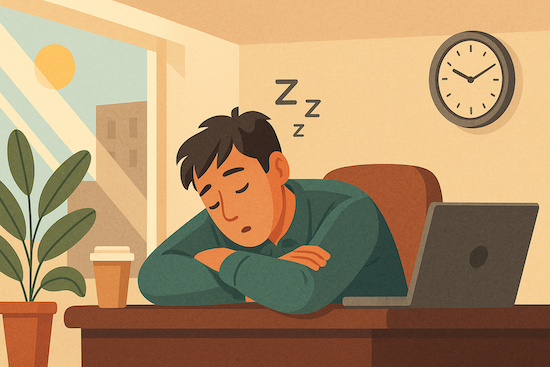
In brief: Light, movement and micro-breaks: ideas to consider when you feel sleepy.
Daytime sleepiness: when tiredness steals your day
Feeling sleepy during the day is more than just an inconvenience.
It affects concentration, mood, productivity, and safety.
If you often fight to stay awake, your nights — or your habits — may need a closer look.
Why does daytime sleepiness happen?
Common causes include:
- Insufficient sleep — not enough hours over time.
- Poor sleep quality — frequent awakenings, restlessness.
- Irregular schedules — late nights, weekend sleep shifts.
- Medical issues — sleep apnea, narcolepsy, depression, thyroid problems.
- Lifestyle factors — caffeine too late, alcohol, or too little daylight.
Why it matters
Daytime sleepiness can make work, study, driving and everyday life harder.
Persistent or marked sleepiness may warrant assessment for a sleep disorder or another cause [8].
Practical strategies to fight daytime sleepiness
- Morning light exposure: Try some daylight after waking if practical; the amount that suits you depends on your schedule.
- Stay active: Try occasional short movement breaks when you feel sluggish.
- Smart naps: Short naps (around 15–25 minutes) early in your wake period may suit you; watch whether they affect later sleep.
- Notice heavy meals and alcohol at lunch: Some people feel drowsier afterwards; see whether that applies to you.
- Limit caffeine to earlier hours: Caffeine close to your planned sleep may make falling asleep harder; the clock time varies.
When to worry
- You regularly fall asleep in calm situations (TV, reading, as a passenger).
- You feel tired despite sleeping 7–9 hours most nights.
- Others notice loud snoring or breathing pauses.
- Sleepiness during driving or safety-critical tasks needs immediate attention.
These can point to conditions like sleep apnea or narcolepsy. In such cases, a medical check is essential.
Sleepiness is not the same as tiredness
Sleepiness is a tendency to doze; fatigue can feel like low energy without actually falling asleep. Both can be disruptive, but the distinction helps when describing your experience to a clinician. In research, daytime sleepiness is often measured through self-report; the Epworth Sleepiness Scale asks about chances of dozing in ordinary situations [8]. The questions on this site are different: we do not use the ESS questions or ESS scoring. Notice whether you actually nod off as a passenger, during a conversation or while reading, and whether this happens even after enough time for sleep.
Check the opportunity for sleep first
Think about when you had to wake and when you could realistically go to bed during the past week. Adult guidance of 7–9 hours is a useful reference point, not a promise that everyone who spends that long in bed will be alert [1]. Work schedules, caregiving and fragmented sleep can make the available window shorter than it looks. If the window is consistently too short, see whether any obligation can be moved; if it is not, don't simply conclude you lack discipline. A short planned nap or a movement break may be a practical way to get through a difficult day, but neither identifies or treats the underlying cause.
Safety comes first
If you are struggling to remain awake while driving or operating machinery, stop safely and arrange another way to continue; coffee or an open window is not a substitute for being alert. Repeated unintended dozing warrants assessment even if you think you have found an explanation. When seeking help, mention snoring, breathing pauses reported by someone else, medicines, work hours and how long the problem has been present. Those details are more informative than a single score.
Using the everyday suggestions
The practical tips about daylight, activity, earlier caffeine and short naps are options to try, not guaranteed fixes. Notice whether a late nap delays your next sleep period. Avoid treating an exact daylight or caffeine cut-off as universal: timing depends on when you plan to sleep, particularly for shift workers. A systematic review and meta-analysis of short daytime naps found associations with better cognitive performance in the included studies, but it cannot say whether a nap will help you or replace adequate night sleep [51]. Persistent sleepiness despite a reasonable sleep opportunity deserves professional attention.
Key takeaway
Daytime sleepiness is not just “being lazy” — it’s a signal from your body.
A steady routine, daylight and small adjustments are reasonable to try, but persistent sleepiness merits professional assessment.
Limitations
Feeling drained and actually falling asleep during the day are different experiences; these questions cannot distinguish every cause.
Local context
Whether daytime napping is socially accepted varies from culture to culture, and so do typical working hours and siesta traditions. Rules about driving with a sleep disorder also differ between countries and licensing authorities. If you repeatedly doze off unintentionally, talk to a local health professional, ask whether there are driving rules where you live, and avoid driving while sleepy.
Sources
- 1. Watson NF et al. (2015). J Clin Sleep Med 11(6):591–592. PMID 25979105
- 8. Johns MW (1991). Sleep 14(6):540–545. PMID 1798888
- 51. Dutheil F, Danini B, Bagheri R, et al. (2021). Int J Environ Res Public Health 18(19):10212. PMID 34639511