
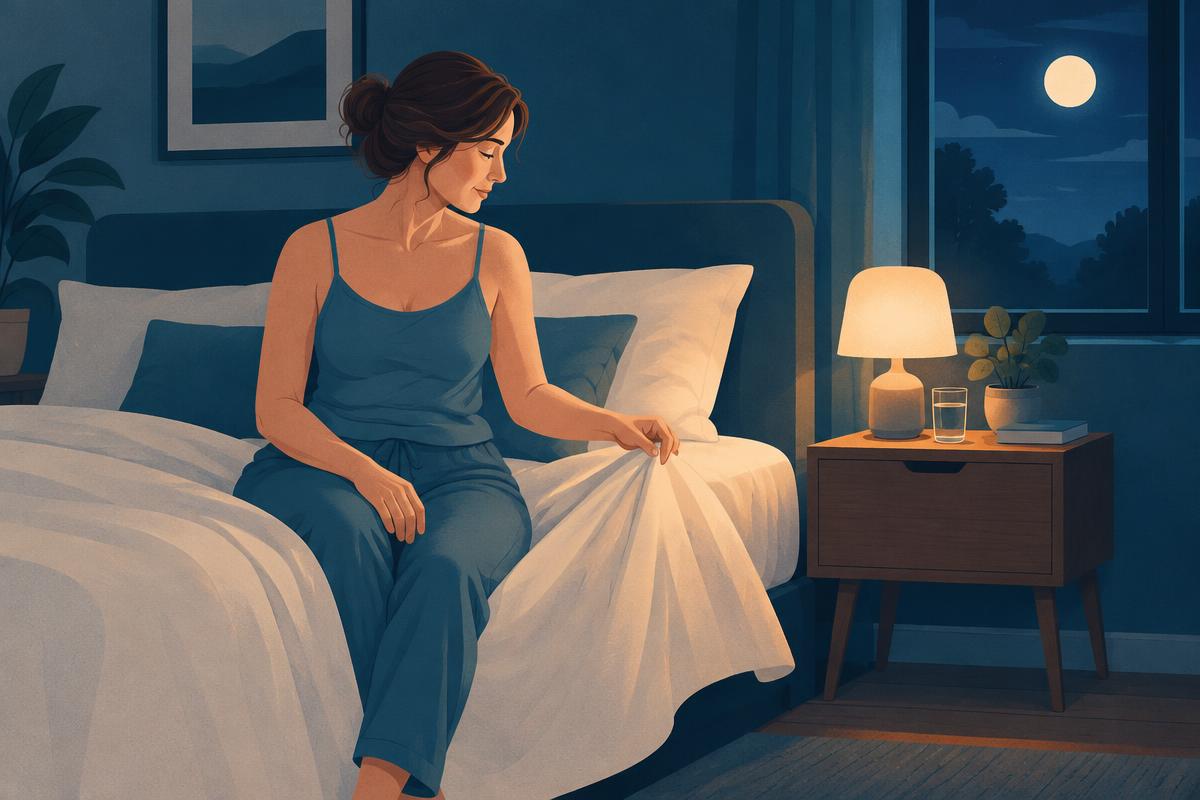
In brief: Sleep across menstrual and menopausal phases, night sweats, and why this module stays outside the sleep score. In this article, you can look at the evidence behind the topic and how it relates to your own sleep. The practical steps are options to try, not promises that they will improve your sleep. A sleep questionnaire cannot identify the cause of a problem or replace an individual assessment.
Hormonal phases, menopause and sleep
Sleep can change alongside the menstrual cycle and during the transition to menopause. Not everyone notices a pattern, and a few answers on a website cannot explain why a particular night was difficult. Sleep Test shows its hormonal-phase questions only after the female choice in the sex question. This is a questionnaire design choice, not a statement that every woman menstruates or that people of other genders cannot experience hormonal changes. The module describes experiences; it is not a diagnosis or a measure of hormone levels.
Why is the module shown only with the female choice?
The two questions were written about changes before a period or after periods stop, and waking hot or sweaty at night. The test asks about sex to decide whether to show those questions. This simple branching inevitably misses some people who could find the topic relevant, including people who do not choose the female option but have menstrual cycles or are going through menopause. It can also show irrelevant questions to women who do not have these experiences. A person's sex response does not tell us their age, cycle status, medications or hormonal history. An unanswered or absent module must not be read as evidence of no symptoms.
The questions are deliberately outside the sleep score. They concern life phase and symptoms that may help explain a pattern, rather than measuring how good someone's sleep is overall. The main score already includes sleep experiences such as waking at night and feeling unrefreshed. Adding a hormonal-phase score to it could count related experiences twice or imply that a normal phase of life is itself a sleep deficit. The method page describes which eight areas actually contribute to the number.
Sleep across the menstrual cycle
Hormone levels vary over the cycle, but the relationship with sleep is not the same for everybody. A review of research on women's sleep describes differences in reported sleep and sleep physiology across reproductive stages [22]. Some people report trouble sleeping or feeling less rested around menstruation; others notice no repeatable change. Pain, mood, stress, work times and other factors can matter at the same time. A few nights that happen to fall before a period do not prove a hormonal cause. Tracking dates may help you describe your own experience, but it cannot identify a hormonal disorder.
Question q40 asks whether you notice changes before your period or after periods have stopped. It joins two distinct situations in one question; a high response cannot tell the test which situation applies. That is a limitation of the wording, not something the score can resolve. If you are concerned about a new or disruptive pattern, describe the timing and the symptoms to a clinician rather than relying on an online interpretation.
Menopause, hot flushes and night sweats
During the menopause transition, some people notice more awakenings and changes in how rested they feel. Hot flushes can occur at night; waking suddenly hot or sweaty can interrupt sleep and make it difficult to settle again. The review [22] discusses sleep across this transition, including symptoms and other factors that may occur together. Not every awakening or episode of sweating is caused by menopause. Room temperature, other health conditions and medicines can also be relevant. The second question, q41, simply asks whether you often wake feeling too hot or sweaty; it cannot distinguish the causes.
Experiences vary widely. Some people find their sleep barely changes, while others have bothersome symptoms. Neither a high nor a low answer here establishes the phase you are in. This page does not recommend hormone therapy or any other medication. If night sweats are frequent, severe, new or accompanied by other concerning symptoms, discuss them with your doctor, who can consider your full circumstances.
Practical ways to observe your own pattern
- If you want to, note bedtime, awakenings and how rested you feel for a few weeks, alongside period dates or hot episodes. Keep it simple enough not to become another source of worry.
- If you wake overheated, try adjustable layers of bedding or a room temperature that feels comfortable to you. There is no single ideal temperature for everyone.
- Write down changes in routine, stress or medication that happen at the same time. Timing alone does not prove a cause, but details can support a useful conversation.
- If sleep disruption affects your days, tell a clinician what changes, when it occurs and how much it interferes. Ask about possible explanations rather than assuming all symptoms have one cause.
- If tracking itself makes you anxious, you do not need to keep a nightly log to deserve help.
These are observation and comfort options, not promises of improved sleep and not instructions to start or stop a medical intervention. The sleep environment article covers light, sound and temperature more generally; this module adds context about timing and symptoms, not a new score.
Key takeaway
Use the suggestions above as options to consider, not as a checklist you must complete. Your answer to one question cannot explain every night or tell you which cause matters most. Notice what happens over several nights and bring specific concerns to a healthcare professional when they persist. This report describes your own answers; it does not measure your sleep or replace an individual assessment.
Menstrual and menopausal phases can coincide with changes in sleep, but individual experiences vary and this short module cannot identify their cause. It appears after a female choice because of how the questions are phrased and stays outside the sleep score because life phases are not sleep-quality points. Bring persistent or troubling symptoms to a doctor for a personal assessment.
Sources
- Baker FC et al. (2018). Nat Sci Sleep 10:73–95. PMID 29445307