
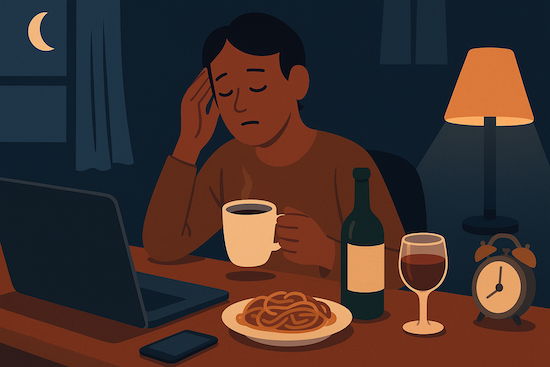
In brief: Screens, caffeine, alcohol and wind-down: habits you can consider.
Sleep hygiene: the habits that shape your nights
Good sleep is not just about how many hours you spend in bed — it’s also about the routines and signals you give your body.
This is where sleep hygiene comes in: everyday habits you can adjust if they appear to affect your sleep [9].
Why sleep hygiene matters
Your brain and body rely on clear signals to know when it’s time to rest.
Late caffeine, bright screens and inconsistent bedtimes may make sleep more difficult for some people [9, 10, 12].
Problems some people notice alongside disrupted routines include:
- Longer time to fall asleep
- More awakenings during the night
- Feeling less rested in the morning
Core principles of good sleep hygiene
- Keep consistent times: Go to bed and wake up at roughly the same time, even on weekends.
- Wind down before bed: 30–60 minutes of calm routines (dim lights, reading, gentle music).
- Limit screens: Light and engaging content can keep some people awake; try lowering brightness or choosing quieter content [12].
- Watch caffeine and nicotine: Both are stimulants that can linger for hours. Try keeping caffeine away from your planned bedtime; a fixed clock-time cut-off does not fit everyone [10].
- Skip alcohol as a sleep aid: It may make you drowsy, but reviews describe changes in sleep later in the night [11].
- Light evening meals: Heavy food late can cause discomfort and poor sleep.
Tips for a better bedtime routine
- Create a “bedtime ritual” — repeating calming activities may be a useful way to wind down.
- Keep the bed for sleep (and intimacy) only — not for TV, work, or scrolling.
- Try gentle stretches, breathing exercises, or journaling to let go of stress.
When habits aren’t enough
If you’ve improved your sleep hygiene but still suffer from insomnia, it may be time for further steps, such as cognitive behavioral therapy for insomnia (CBT-I) — a structured treatment distinct from everyday habits.
A realistic approach to timing
Sleep-hygiene advice is a set of possible habits, not a checklist you must complete before you are allowed to sleep. A review of sleep-hygiene research finds that support varies between recommendations [9]. Choose a change that addresses an actual problem you notice. If you drink coffee late and lie awake, try moving the last cup earlier and observe what happens. An experimental study found effects even when caffeine was consumed six hours before bedtime [10], but sensitivity varies between people. For a night worker, “afternoon” may have little meaning: count back from planned sleep instead.
Alcohol, screens and evening exercise
Alcohol may bring on drowsiness yet be followed by a more disrupted night; a review describes different effects across sleep stages and timing [11]. Light-emitting reading devices have been studied for effects on circadian timing and alertness [12]; that does not mean every screen has the same effect on everyone. If scrolling keeps you awake, set it aside; if quiet reading is part of a workable routine, consider the light and content as well as the device. Evening exercise usually does not worsen sleep in pooled studies; a vigorous session ending very close to bedtime may be an exception [13]. Keep activity that fits your day rather than avoiding all evening movement.
Test one practical change
Write down the obstacle you actually face: a late stimulant, an uncomfortable dinner, an unsettled mind or insufficient time in bed. Pick one of the suggestions and try it consistently enough to notice whether it suits you. For example, prepare a calmer activity before bed, keep your preferred reading but dim its light, or shift caffeine earlier. If you make many changes at once, it becomes harder to know which, if any, mattered. The goal is a workable routine, not a perfect bedtime.
When routines are not treatment
Persistent insomnia can continue even when someone follows every common sleep-hygiene tip. Multicomponent CBT-I is a structured treatment for chronic insomnia, not merely advice about screens and drinks. Ask a clinician about it if difficulties persist or affect daily life. Keeping the simple tips as options does not mean claiming they will cure insomnia.
Key takeaway
Good sleep hygiene is about consistency, timing, and signals.
Experiment with habits that fit your circumstances; if problems persist, habits alone may not be enough.
Limitations
Advice about caffeine and screens depends on your schedule and sensitivity; following every routine cannot exclude persistent insomnia.
Local context
Caffeine comes from different sources around the world: coffee, tea, mate, cola and energy drinks are all common, and serving sizes vary. Meal times and evening social habits also differ between cultures, from early dinners to late ones. Rather than adopting a clock time from another country, compare your last caffeine and your last large meal with the time you actually plan to sleep.
Sources
- 9. Irish LA et al. (2015). Sleep Med Rev 22:23–36. PMID 25454674
- 10. Drake C et al. (2013). J Clin Sleep Med 9(11):1195–1200. PMID 24235903
- 11. Ebrahim IO et al. (2013). Alcohol Clin Exp Res 37(4):539–549. PMID 23347102
- 12. Chang AM et al. (2015). PNAS 112(4):1232–1237. PMID 25535358
- 13. Stutz J et al. (2019). Sports Med 49(2):269–287. PMID 30374942