
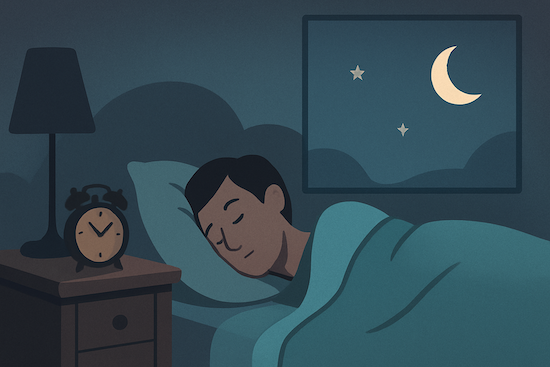
In brief: Practical ways to fall asleep faster and handle nighttime wake-ups.
Insomnia: when nights feel too long
Struggling to fall asleep, waking up often, or waking too early?
That’s insomnia — one of the most common sleep issues. Almost everyone has a rough night now and then, but when it becomes frequent, it can affect mood, energy, and health.
What is insomnia?
Insomnia isn’t just “not sleeping enough.” It’s about:
- Difficulty falling asleep (taking a long time to drift off).
- Frequent awakenings during the night.
- Early morning waking without being able to fall back asleep.
- Poor rest even after a full night.
Stress, travel or changes in routine can coincide with short-term difficulties. Persistent symptoms and daytime effects deserve assessment; do not use this description alone to decide whether you have chronic insomnia [5].
Why it matters
Poor sleep chips away at mental sharpness, mood, and physical health.
Persistent insomnia is associated with other health concerns, but association is not proof that insomnia alone causes each outcome [19].
What helps?
For chronic insomnia, clinical guidelines recommend cognitive behavioral therapy for insomnia (CBT-I) [6]. It addresses thoughts and behaviours that may maintain sleep difficulties. But there are also steps you can try yourself:
- Stimulus control: Use your bed only for sleep and intimacy — not TV, work, or doomscrolling.
- Rule of 20 minutes: If you can’t sleep, get up, do something calm in dim light, and try again later.
- Fixed wake-up time: Keep a steady morning anchor, even after bad nights.
- Wind-down routine: Gentle activities (reading, music, stretching) tell your body it’s time for bed.
- Avoid sleep pressure traps: Spending more and more time in bed often backfires.
When to seek help
If sleep problems last more than a few weeks, or you notice big impacts on daily life, talk to a doctor. They can help check for underlying conditions and guide you to CBT-I or other treatments.
Sleep difficulty versus a bad night
Occasional trouble sleeping is common, especially around stressful events. Insomnia involves both night-time difficulties and their impact while awake; counting minutes once is not enough to decide whether you have a disorder. The Insomnia Severity Index considers perceived severity and consequences, but this site's questions are not that instrument [5]. If you note sleep for a week or two, include how much time you set aside for sleep, when you actually slept and whether your days were affected. Estimates made in the middle of the night are often imprecise, so use your notes as a conversation aid, not a diagnosis.
Trying the steps without turning them into rules
The bed-only-for-sleep suggestion aims to make the bed less closely associated with frustration. If you cannot sleep and feel increasingly tense, a calm activity elsewhere may feel preferable to clock-watching. The “20 minutes” in that rule is a rough cue, not a deadline: there is no need to check the clock repeatedly. A steady wake time can be an anchor, but keep enough opportunity to sleep and account for shift work, childcare or illness. A wind-down routine should be something you can actually repeat, not another source of pressure.
What structured care adds
CBT-I is more than a checklist of good habits. It combines several approaches and should be adapted to an individual's situation; clinical guidelines recommend multicomponent CBT-I for chronic insomnia [6]. Techniques that change time in bed are best discussed with a qualified professional, especially if safety or other health conditions are relevant. Models of insomnia describe how arousal and worry may help maintain difficulties [19], but they do not mean every person's sleep problem has the same cause. If your difficulties continue, bring your notes and describe what you have already tried when you seek care.
Key takeaway
Insomnia is frustrating — but it’s not hopeless. The suggested habits may be worth trying, but they do not work for everyone. For lasting issues, ask about structured CBT-I [6].
Limitations
These answers do not establish whether your difficulties meet the criteria for chronic insomnia or whether CBT-I suits your circumstances.
Local context
Access to structured care for long-lasting insomnia differs between countries. In some places a general practitioner provides the first assessment and can refer you on; elsewhere you may contact a sleep clinic or psychologist directly. Cost and insurance coverage vary, and online programmes may or may not be offered through public health services. Your local health service can explain what applies where you live.
Sources
- 5. Bastien CH et al. (2001). Sleep Med 2(4):297–307. PMID 11438246
- 6. Edinger JD et al. (2021). J Clin Sleep Med 17(2):255–262. PMID 33164742
- 19. Riemann D et al. (2010). Sleep Med Rev 14(1):19–31. PMID 19481481