
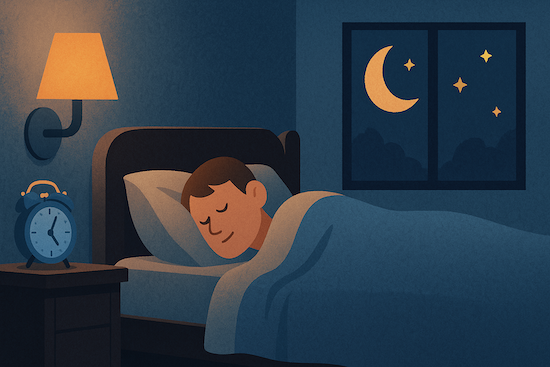
In brief: Reduce common disrupters and explore what may be disrupting your sleep.
Sleep quality: more than just hours in bed
Not all sleep is equal. You can spend 8 hours in bed and still feel tired.
Sleep quality is about how refreshing and stable your sleep is, not just how long it lasts.
What defines good sleep quality?
Good sleep usually means:
- Falling asleep within ~20–30 minutes.
- Sleeping mostly through the night, with few awakenings.
- Waking up feeling rested and alert.
- No major disturbances like pain, nightmares, or restlessness.
If you wake often, toss and turn, or feel unrefreshed, your sleep quality may be poor — even if your total hours look fine.
Why it matters
Sleep quality is one of several dimensions examined alongside health [26]; that does not establish that a change in perceived quality prevents a particular disease.
What can disrupt sleep quality?
- Stress or anxiety — racing thoughts at night.
- Pain or discomfort — from back, joints, or restless legs.
- Environmental factors — light, noise, temperature.
- Alcohol or late heavy meals — cause fragmented sleep.
- Medical issues — depression, sleep apnea, or other conditions.
How to improve sleep quality
- Track triggers: Notice what affects your nights — caffeine, late exercise, stress levels.
- Reduce disruptions: Blackout curtains, earplugs, cooler bedroom, comfortable bedding.
- Wind down before bed: Create a routine that signals sleep.
- Address pain or discomfort: Don’t ignore physical issues that wake you.
- Seek help if persistent: A sleep doctor or therapist can guide treatment if problems continue.
When to seek help
If you often wake unrefreshed despite enough sleep, or your nights feel fragmented without clear cause, it’s worth talking to a doctor. Sometimes underlying conditions (like sleep apnea or mood disorders) are the hidden reason.
Looking beyond one number
A sleep tracker may report a duration or a “quality score,” but your own experience also matters. The Pittsburgh Sleep Quality Index includes subjective quality, latency, duration, efficiency, disturbances, medication use and daytime effects over the past month [7]. This test does not administer that questionnaire, and its category result should not be read as a clinical PSQI result. You can still use a few of those dimensions to describe what is bothering you: is it the time taken to fall asleep, repeated waking, or feeling unrefreshed?
There is no single objective measurement that captures every aspect of a person's sense of a good night. A concept analysis describes sleep quality in terms of several related attributes, including time to fall asleep and time awake during the night [47]. A separate review discusses sleep satisfaction as a related but not identical idea [48]. These papers clarify the terms; neither validates Sleep Test's quality score or proves that a change in it prevents illness.
Spotting a disturbance without blaming yourself
Try recording the nights that feel different and what else happened: pain, noise, a new work schedule, alcohol, illness or caregiving. A pattern over time is usually more useful than one exceptional night. The point is to identify a practical question to investigate, not to prove that one food, screen or worry caused every awakening. Some awakenings are normal; the concern is how frequent and disruptive they are for you. If you have enough time in bed but are still very sleepy, consider whether breathing symptoms, medicines or another issue deserves assessment.
Small changes worth trying
Try practical changes: try reducing a specific source of noise or light, adjust bedding if you are uncomfortable, and give yourself a quieter transition before bed if evenings are hectic. Change one thing at a time if you want to tell whether it feels useful. These are low-stakes experiments, not established cures. If pain wakes you, dealing with the pain matters more than buying a new pillow on a hunch. Scientific statements discuss sleep in the wider context of health [26], but they do not show that improving a score here will prevent illness.
When the question is medical
Persistent unexplained awakenings, breathing pauses, marked daytime sleepiness or significant distress deserve a discussion with a clinician. Describe the timing and effects rather than bringing only a number from an app. This can help distinguish a disrupted environment from a problem that needs a different kind of assessment.
Key takeaway
Sleep quality is about depth and continuity, not just quantity. A calm routine, a comfortable environment and awareness of possible triggers are reasonable things to try; none guarantees improvement. Persistent problems deserve assessment.
Limitations
Your own sense of rest is important, but a quality score cannot identify whether pain, breathing or another factor explains unrefreshing sleep.
Local context
If you seek advice about unrefreshing sleep, the route depends on your country: some health systems start with a general practitioner, while others let you book a specialist directly, with costs and coverage that vary. Wherever you live, a simple diary of bedtimes, awakenings and how you feel during the day gives a clinician something concrete to work with, whatever language or units you use.
Sources
- 7. Buysse DJ et al. (1989). Psychiatry Res 28(2):193–213. PMID 2748771
- 26. St-Onge MP et al. (2016). Circulation 134(18):e367–e386. PMID 27647451
- 47. Nelson KL et al. (2022). Nurs Forum 57:144–151. PMID 34610163
- 48. Protogerou C et al. (2024). Behav Sci (Basel) 14. PMID 39457814