
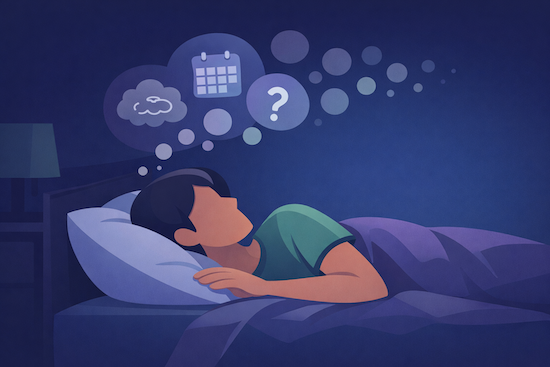
In brief: How stress and a busy mind keep you awake — and ways to calm down. In this article, you can look at the evidence behind the topic and how it relates to your own sleep. The practical steps are options to try, not promises that they will improve your sleep. A sleep questionnaire cannot identify the cause of a problem or replace an individual assessment.
Stress and racing thoughts: when the mind won’t switch off
Feeling tired but unable to fall asleep is a common experience.
Stress, worry and racing thoughts may accompany difficulty falling asleep — even when sleep habits are otherwise good.
Why mental stress affects sleep
Many people find it harder to sleep when they feel highly alert.
Stress does the opposite.
Models of insomnia describe heightened activation, sometimes called hyperarousal, as one possible factor in difficulty falling or staying asleep [19].
Sleep researchers describe this heightened activation as one possible mechanism behind insomnia [19].
Common signs
- Racing thoughts when going to bed
- Long time to fall asleep, despite feeling tired
- Frequent awakenings with a restless or tense feeling
- Sleep problems that worsen during stressful periods
- Daytime effects like poor focus, low energy, or irritability
These experiences can occur together, but cannot establish a particular diagnosis. The National Institutes of Health explains the signs of insomnia.
Why good sleep habits may not be enough
Sleep hygiene — limiting screens, keeping a regular bedtime, and having a quiet bedroom — is important.
But when stress is the main driver, these steps alone may not resolve the problem.
That’s why approaches targeting mental activation, such as cognitive behavioral therapy for insomnia (CBT-I), are considered first-line treatment for persistent insomnia [6]. The Sleep Foundation explains CBT-I in more detail.
Practical tips
- Wind down intentionally: Allow 45–60 minutes before bed for calm, low-demand activities.
- Write worries down: Writing concerns earlier in the evening is a low-pressure option to try. The NHS offers practical ideas for handling worries.
- Slow your breathing: Slow breathing may feel calming for some; try another activity if it feels uncomfortable.
- Get out of bed if you’re wide awake: Doing something quiet until sleepiness returns may make the time in bed feel less frustrating.
When to seek help
If sleep problems persist for weeks, significantly affect daily functioning, or don’t improve with self-care, it may be helpful to speak with a healthcare professional.
Notice the pattern without assigning blame
It can help to distinguish a stressful week from an ongoing difficulty with sleep. Note when thoughts become more active, whether you feel tense before bed and whether you also wake during the night. Cognitive models of insomnia discuss worry about sleep and the attention paid to signs of wakefulness [20]; other models examine heightened arousal [19]. These are ways researchers describe possible processes, not proof that worry explains your particular sleep problem. Pain, breathing symptoms, work hours and other concerns may also matter.
Keep gentle strategies gentle
The practical suggestions can be tried as options. Write tomorrow's tasks down earlier in the evening if that helps you put them aside; keep the list short enough not to become more work. Reading, music, a familiar routine or slow breathing can be ways to pass a tense evening, not techniques you must perform correctly. If you feel more anxious when monitoring your breathing, choose another quiet activity. If lying awake turns into clock-watching, getting up briefly and returning when sleepy is an option rather than a strict rule.
When general tips are not enough
A calm routine might make evenings more pleasant, but it is not the same as treatment for persistent insomnia. Clinical guidance recommends multicomponent CBT-I for chronic insomnia [6]. A professional can also help assess whether distress, mood symptoms or something else deserves attention. If you are experiencing significant distress, seeking help need not wait until every lifestyle tip has been tried. Bring examples of what your nights and days are like rather than worrying about fitting a specific label.
Keep the bigger picture
A difficult night does not mean you have failed to manage stress. It is possible to keep a steady morning routine and make room for worries at another time while also acknowledging that sleep is not fully under voluntary control. If practical steps do not fit your circumstances, adapt them instead of forcing a rigid schedule.
Key takeaway
Use the suggestions above as options to consider, not as a checklist you must complete. Your answer to one question cannot explain every night or tell you which cause matters most. Notice what happens over several nights and bring specific concerns to a healthcare professional when they persist. This report describes your own answers; it does not measure your sleep or replace an individual assessment.
Stress and racing thoughts can coincide with disrupted sleep.
If your mind won’t switch off at night, the solution may lie not in stricter sleep rules — but in helping your body and brain slow down.
Sources
- Riemann D et al. (2010). Sleep Med Rev 14(1):19–31. PMID 19481481
- Harvey AG (2002). Behav Res Ther 40(8):869–893. PMID 12186352
- Edinger JD et al. (2021). J Clin Sleep Med 17(2):255–262. PMID 33164742