
In brief: One bad night rarely does lasting harm. Treating it as a disaster often makes the next night worse. Research on insomnia shows that worry, constant monitoring and rigid rules about sleep can keep the problem going. A calmer, learning-focused attitude to your sleep habits is easier to keep up and fits better with the approaches that have the strongest evidence.
Almost everyone has nights when sleep does not come. What happens next depends partly on the night itself and partly on how you interpret it. "I will be useless tomorrow" and "I am someone who just cannot sleep" are not neutral observations. They are beliefs, and beliefs affect how alert, tense and watchful you feel when you next go to bed. This guide looks at that loop, at the role of sleep trackers and online sleep content, and at a practical way to approach sleep habits as something you can adjust over time.
How beliefs about sleep feed back into sleep
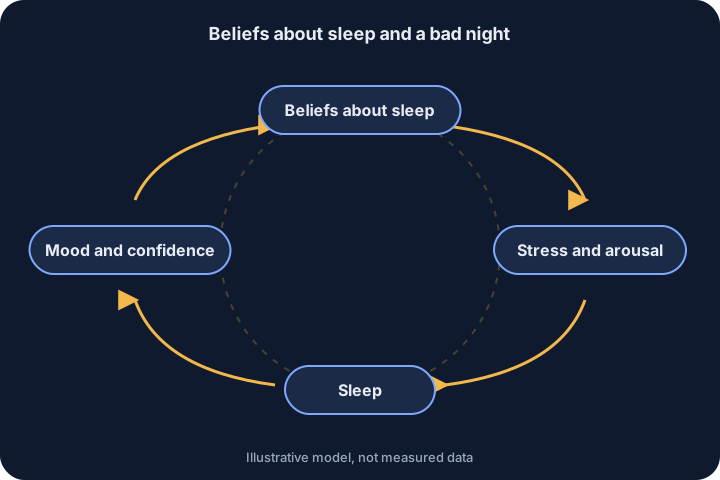
The cognitive model of insomnia describes a cycle that many people will recognise [20]. Worry about sleep raises arousal and distress. An anxious mind then starts scanning for threats: the clock, the heartbeat, the feeling of not being sleepy. That scanning makes small signals seem bigger, and people often underestimate how much they actually slept. To protect themselves, they adopt "safety behaviours" such as cancelling plans, lying in bed longer or drinking more coffee, which can unintentionally keep the problem going.
A related line of research describes insomnia as a state of hyperarousal: the body and brain stay more activated than the situation requires, both at night and during the day [19]. You do not need a diagnosis for the basic idea to apply. If going to bed has become a performance you are anxious about, the anxiety itself is part of what keeps you awake.
Why catastrophising a bad night can make it worse
Catastrophising means jumping from a real event to the worst plausible outcome: "I slept badly, so the presentation will fail, so my job is at risk." The thought feels protective, but it adds stress at exactly the moment you want your body to settle. In the cognitive model, worry and selective attention to sleep-related threats are central maintaining factors, not side effects [20].
A more useful response separates the facts from the forecast. The fact: you slept less than you wanted. The forecast: tomorrow might feel harder. Many people find they function better than they feared after one short night, even if they feel tired. Noticing that, rather than assuming the worst every time, gradually weakens the link between a bad night and alarm.
Perfect-sleep content, trackers and social media
Online sleep content often promises an optimised night: the right score, the right routine, the right supplement. For some people, aiming for perfect data becomes a new source of stress. Clinicians have described cases where the pursuit of ideal sleep-tracker results became part of the sleep problem, a pattern they called orthosomnia [29]. That report describes clinical cases; it does not show that trackers harm sleep for everyone.
Screens before bed can also matter in their own right. In a survey of young adults in the United States, more frequent social media use in the 30 minutes before bed was associated with more sleep disturbance [55]. The study was cross-sectional, so it cannot show which came first, but it is a reasonable prompt to notice how late-night scrolling affects you. Our review of viral sleep hacks from TikTok and Reddit checks 18 popular claims against the research, and our guide to stress, racing thoughts and sleep covers ways to wind down a busy mind.
Sleep, mood and emotional resilience
Sleep and mood influence each other in both directions. A tired day can feel more irritable and less manageable, and a stressful day can make it harder to switch off at night. Treating that link as fixed ("bad sleep ruins everything") tends to strengthen it. Treating it as something you can respond to, with a quieter evening, daylight in the morning or a kinder interpretation of a hard day, keeps more options open.
Resilience here does not mean ignoring problems. It means expecting occasional bad nights, responding with steady habits rather than drastic compensations, and taking persistent difficulties seriously enough to get help.
A growth-oriented approach to sleep habits
Research on growth mindset, the belief that abilities can develop with effort and good strategies, comes mainly from education. A large national experiment in the United States found that a short online growth-mindset programme improved grades among lower-achieving secondary school students [57]. A set of meta-analyses found the overall links between mindset and achievement to be weak and intervention effects small, with larger benefits for some groups [58]. The evidence is therefore modest, and it does not test sleep directly.
What can reasonably carry over is the attitude: treat sleep habits as skills you can practise and adjust, not as a test you pass or fail each night. In practice that might look like:
- Keep a regular wake time most days, even after a poor night, instead of trying to "catch up" by staying in bed.
- Run small experiments. Change one thing, such as an earlier screen cut-off, for two weeks and notice what happens, rather than overhauling everything at once.
- Use data gently. If a tracker score makes you anxious, check it less often or take a break from it.
- Replace verdicts with descriptions. "I slept about five hours" is more useful than "I failed at sleep again."
- Know when habits are not enough. For long-lasting insomnia, the American Academy of Sleep Medicine recommends cognitive behavioural therapy for insomnia (CBT-I), a structured treatment that works directly on these patterns [6].
The sister site's guide to sleep and a growth mindset looks at the mindset side in more depth, and our partner's article on how sleep affects cognitive performance explains what a short night does to attention and memory.
Frequently asked questions
Can one bad night really affect how I sleep the next night? It can, mostly through what happens in between. Worrying about the next night, napping for a long time or going to bed very early to compensate can all make it harder to fall asleep. A regular routine usually helps more than compensating.
Is it bad to use a sleep tracker? Not necessarily. Some people find trends useful. If chasing a better score makes you tense or preoccupied, that tension can work against sleep, and taking a break is reasonable [29].
Does a growth mindset cure insomnia? No. Mindset research mainly concerns learning, and the effects are modest [58]. A flexible, learning-focused attitude can make healthy habits easier to keep, but persistent insomnia deserves a proper assessment and, often, CBT-I [6].
Check where you stand: The free Sleep Test takes 5–10 minutes and shows which areas of your sleep may deserve attention. It is not a diagnosis.
Part of our Mind, Brain & Sleep series. Sleep Test, Mindset Test and Brain Test are three free sites from the same team, looking at how sleep, beliefs and thinking connect.
Local context
How sleep is discussed online is much the same across countries, but access to help is not. In some health systems a family doctor can refer you to cognitive behavioural therapy for insomnia (CBT-I); in others it is offered through sleep clinics, psychologists or approved digital programmes, with different costs. Ask your local health service which options exist where you live.
Sources
- 6. Edinger JD et al. (2021). J Clin Sleep Med 17(2):255–262. PMID 33164742
- 19. Riemann D et al. (2010). Sleep Med Rev 14(1):19–31. PMID 19481481
- 20. Harvey AG (2002). Behav Res Ther 40(8):869–893. PMID 12186352
- 29. Baron KG et al. (2017). J Clin Sleep Med 13(2):351–354. PMID 27855740
- 55. Levenson JC et al. (2017). Sleep 40(9):zsx113. PMID 28934521
- 57. Yeager DS et al. (2019). Nature 573(7774):364–369. PMID 31391586
- 58. Sisk VF et al. (2018). Psychol Sci 29(4):549–571. PMID 29505339