
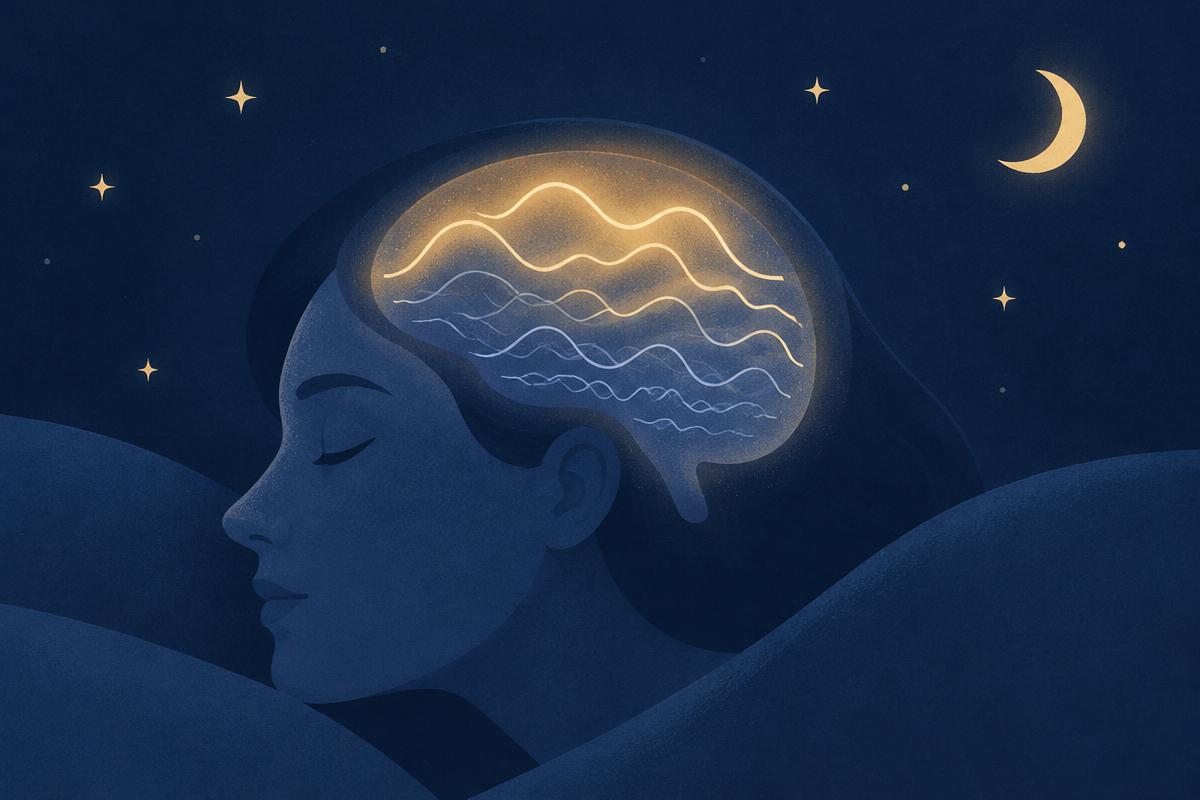
In brief: Sleep affects how well you think the next day. Short-term sleep loss most clearly weakens attention and slows reactions. Sleep after learning helps the brain consolidate new memories. If you want a fair result on a cognitive test, take it rested, at a consistent time of day, and not straight after a late night on your phone.
Most people know the foggy feeling after a short night. Research helps to explain what is behind it: which mental abilities suffer first, why sleep matters for memory, and why the timing of a test can change the result. This guide summarises that evidence in plain language and ends with practical advice for anyone about to take a memory, attention or reasoning test.
What sleep loss does to attention and reaction time
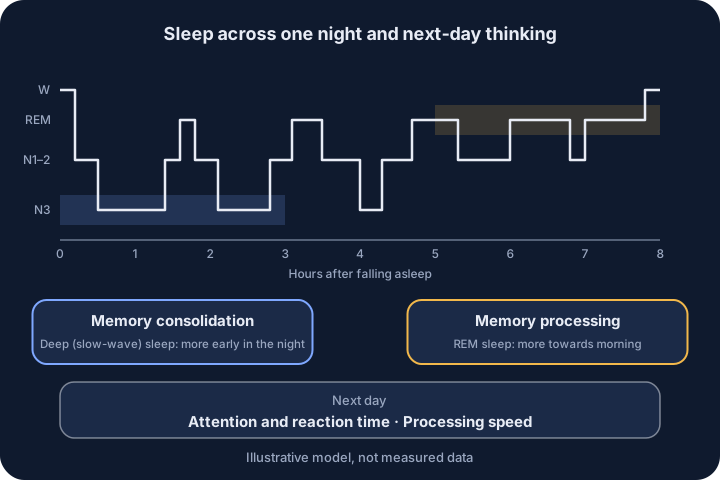
A meta-analysis of short-term sleep deprivation studies found that the largest effects were on simple and sustained attention: staying focused on a dull task and reacting quickly when something happens [53]. Effects on more complex tasks, such as reasoning, were smaller and more variable. In everyday terms, a tired brain is less reliable rather than simply slower: most responses may be fine, but lapses, moments when attention briefly drops out, become more frequent.
This matters for tasks that rely on steady attention, such as driving, monitoring a screen or working through a timed test. It is also why a short night can feel manageable in an interesting conversation but much harder in a long, repetitive task.
Working memory and processing speed
Working memory is the ability to hold and use information for a few seconds, such as a phone number or the steps in a calculation. Processing speed is how quickly you can take in information and respond. In the same meta-analysis, working memory and processing tasks were also affected by sleep deprivation, although less consistently than simple attention [53]. Results depend on the task, how long people were kept awake and individual differences in vulnerability.
How sleep helps memory consolidation
Sleep is not just downtime for memory. A major review describes how sleep after learning supports consolidation: new, fragile memories are stabilised and integrated with existing knowledge [52]. Slow-wave sleep, the deep sleep that is most common early in the night, is linked especially to fact- and event-type memories, while REM sleep, more common towards morning, has been linked to some procedural and emotional memory processes. The review stresses that these stages work together, and much of the detail is still being studied.
Animal research has also found that sleep increases the clearance of waste products from the brain compared with wakefulness [54]. The study was done in mice, so it does not show what a single short night does to a person's thinking, but it adds to the picture of sleep as an active process.
Late-night scrolling and next-day performance
Evening screen use can affect sleep in several ways: it delays bedtime, keeps the mind engaged and adds light late in the evening. A systematic review of studies in school-aged children and adolescents found that screen time was associated with later bedtimes and shorter sleep in most of the included studies [56]. In young adults, more social media use in the 30 minutes before bed was associated with more sleep disturbance [55]. These are mostly observational studies, so they show associations rather than proof of cause, but the practical point is simple: the hour before bed is a common place where sleep time is lost.
For ideas on winding down, see our guide to sleep hygiene and routines. If you often feel sleepy during the day despite reasonable sleep, our article on daytime sleepiness explains when it is worth talking to a doctor, and sleep quality covers common things that disturb sleep.
When to take a cognitive test
If you want a result that reflects your usual ability, the conditions matter as much as the test itself:
- Be rested. Avoid testing after a clearly short or broken night; attention is the first thing to suffer [53].
- Use a consistent time of day. If you compare results over time, test at roughly the same time each time, so differences in alertness across the day do not get mixed up with real change.
- Keep the evening before ordinary. No late-night scrolling marathon, and no unusual amounts of alcohol or caffeine.
- Do not over-read one score. A single result can vary for many reasons. Look at the pattern over several attempts.
- Be cautious about "brain training" claims. A comprehensive review found good evidence that people improve on the trained tasks, but less evidence that this transfers to everyday thinking [59].
Our partner site explains more about sleep and cognitive performance, and the guide to brain training and a growth mindset looks at how beliefs about ability shape practice.
Frequently asked questions
Does one short night really affect my test results? It can. Short-term sleep loss most clearly affects sustained attention and reaction time, which many timed tests rely on [53]. Effects vary between people and tasks.
Is it better to sleep or study the night before an exam? Cutting sleep to study more works against you: sleep after learning helps memories stabilise [52], and tiredness weakens attention the next day [53]. Spreading study over several days and sleeping normally is usually the better plan.
Can poor sleep be the reason I struggle to concentrate? It can be one reason, but not the only possible one. If concentration problems persist despite enough sleep, or you often fall asleep unintentionally during the day, talk to a doctor.
Check where you stand: The free Sleep Test takes 5–10 minutes and shows which areas of your sleep may deserve attention. It is not a diagnosis.
Part of our Mind, Brain & Sleep series. Sleep Test, Mindset Test and Brain Test are three free sites from the same team, looking at how sleep, beliefs and thinking connect.
Local context
Exam timetables, shift patterns and commuting differ between countries and workplaces, so the time of day you are tested may not be your best. If you compare results over time, test at a similar hour. Rules about driving with daytime sleepiness vary between countries; never drive when you feel drowsy, and raise persistent concentration problems with a doctor.
Sources
- 52. Diekelmann S, Born J (2010). Nat Rev Neurosci 11(2):114–126. PMID 20046194
- 53. Lim J, Dinges DF (2010). Psychol Bull 136(3):375–389. PMID 20438143
- 54. Xie L et al. (2013). Science 342(6156):373–377. PMID 24136970
- 55. Levenson JC et al. (2017). Sleep 40(9):zsx113. PMID 28934521
- 56. Hale L, Guan S (2015). Sleep Med Rev 21:50–58. PMID 25193149
- 59. Simons DJ et al. (2016). Psychol Sci Public Interest 17(3):103–186. PMID 27697851